
Everyone saw the yellow bag. Few looked closely at the handle.
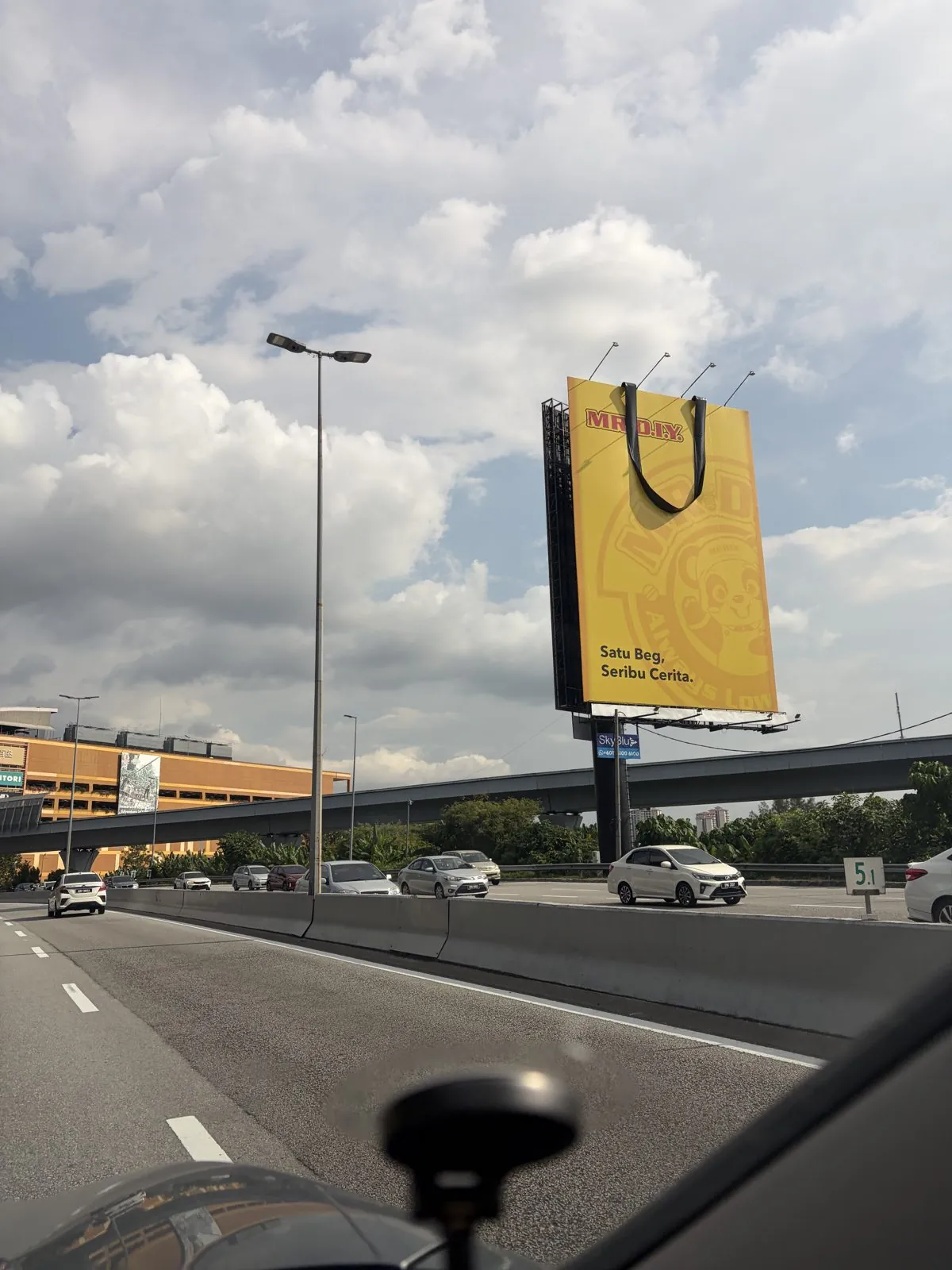
I drove past that yellow bag almost every day for months.
It wasn't the bag that got me. It was the handle.
It wasn't printed. It was sticking out of the billboard.
By now you've probably seen it. In May 2026, MR D.I.Y. (MR DIY to most of us) turned its yellow reusable bag, with over 10 million sold since 2023, into a giant billboard across around 15 high-traffic sites under Satu Beg, Seribu Cerita. Then Malaysia took over. Netizens created AI billboard replies from 99 Speedmart, Grab, Setel and more, and Threads did the rest (source: MARKETING-INTERACTIVE).
The press covered the idea and the buzz. The handle got far less attention.
The RM10,000 handle
From my years of planning and doing installations like this, each protruding handle costs around RM10,000, before a single ringgit of media rental.
Yes. RM10,000. For one handle.
Without it, you have a large, flat picture of a shopping bag. Still recognisable. Still a strong brand asset. But nobody photographs a flat bag.
The handle turned the billboard itself into the story. Which makes RM10,000 less of a production cost and more a question about the economics of attention.
Here's how I see it.
The billboard was already rented. The space was already paid for. The handle was the decision to make the most of it.
Spread across a three-month run (MR D.I.Y. said two to three), each handle works out to about RM3,300 a month. That is within the range of a boosted-post budget. Except this one hangs over a highway and makes people pull out their phones, or simply look up and nod.
And I felt it myself. The more I passed it, the deeper it sank. The billboard didn't feel like an ad. It felt like an invitation. Suddenly a RM2.20 bag felt like something worth carrying with a little more confidence.
A flat print tells you about the bag. The handle made you believe it.
That's what RM10,000 bought.
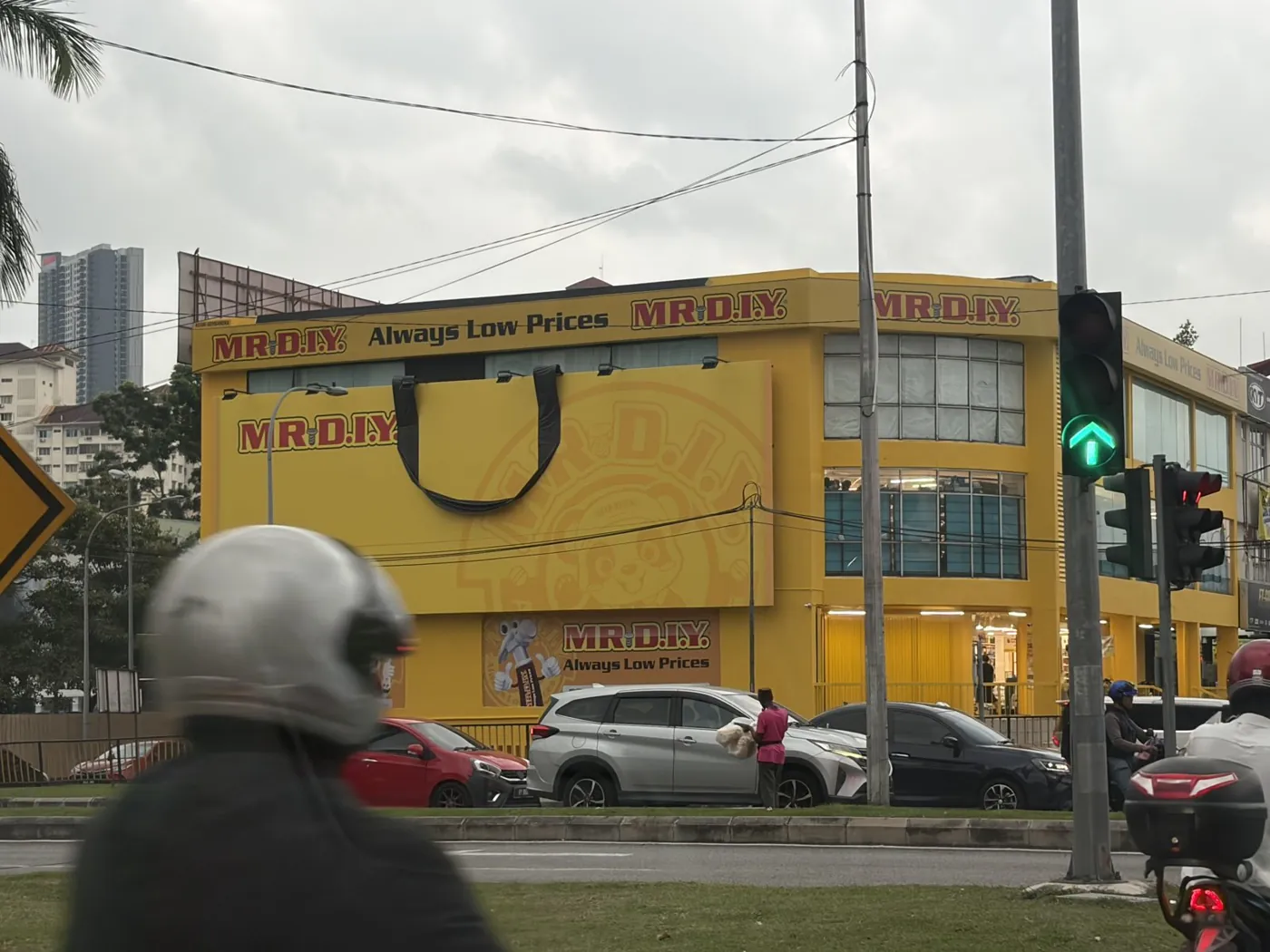
The creative was expensive. Was the attention cheap?
A roadside encounter becomes a photograph. The photograph becomes a post. The post becomes a conversation. The conversation becomes earned media. MR D.I.Y. said it themselves: no media spend went behind the buzz. It was "fully organic so far."
Virality isn't sales. But attention you didn't pay for is still attention.
Are we too focused on reducing the cost of advertising, and not focused enough on increasing the value of what we create?
I've spent most of my career on the planning and buying side of this business. Here's what I've noticed.
We'll fight hard for a 10% discount on rental. We'll argue over traffic counts and loop lengths. But we rarely sit down and ask what a site could become.
A special build doesn't belong everywhere. MR D.I.Y. got this right. They put handles on the larger panels, where the build had room to breathe, and ran flat prints elsewhere. That's not extravagance. That's site selection.
And it can be measured. Not perfectly, but meaningfully. Photos taken. Posts shared. Searches. Footfall around nearby stores.
The best media money isn't always the cheapest. Sometimes it's the RM10,000 that makes the other RM100,000 work harder.
Uber Eats asked a different question
In June 2026, Uber Eats wrapped giant green delivery bags around other brands' billboards across Sydney and Brisbane. The logic was simple: why advertise what Uber Eats can deliver, when other brands are already advertising it? (source: AdNews)
MR D.I.Y. asked: how do we turn an everyday bag into something extraordinary?
Uber Eats asked: how do we make everyone else's advertising work for us?
Two bags. Two markets. Two different approaches. Same lesson: the opportunity wasn't the billboard space. It was a better question about what the space could do.
Most outdoor briefs I receive start with three questions. Where? How much? How many?
They're fair questions. But they're all about buying space. None of them are about what the space could do.
A while back I got stopped on the road by a Zus Coffee screen showing nothing but a Wi-Fi password. No product. No smiling faces. Just text. Same kind of screen everyone else was renting. Completely different question behind it.
That's the pattern. MR D.I.Y. asked what their bag could become at billboard scale. Uber Eats asked what other brands' billboards could become with their bag on top.
The space was never the idea. The question was.
Maybe we're negotiating the wrong things
What fascinates me isn't the size of the bags. It's the decisions behind them.
Someone believed in the idea. Someone approved the extra build. Someone saw that the space could do more than carry a print.
MR D.I.Y.'s VP of marketing, Alex Goh (no relation, though I admire his taste in bags), told MARKETING-INTERACTIVE the ambition was to "build something more emotional for the brand this round." That's where the conversation should start: with what the brand wants to achieve, not what the media costs.
If I could change one thing about how our industry works, it would be this.
- Advertisers: set aside a line in the budget for making it real. Not just media. A build, a twist, something that only works in the physical world.
- Creative agencies: stop adapting the key visual. Design for the site. Where does the driver's eye land? What sits around it? What can stick out?
- Media owners, including us: stop selling panels. Start selling possibilities. Tell clients which sites can carry a special build, what approvals it takes, and how long it needs.
The billboard space is the same for everyone.
What we choose to do with it isn't.
So, was RM10,000 expensive for a bag handle?
Maybe. But if we only talk about what the handle cost, we miss what it created.
The most expensive question in advertising isn't "How much will it cost?" It's the one we forget to ask: "What else could we do?"
My best thinking happens at KM4.8 of the LDP, going nowhere fast. That's Heads-Up.

Alex Goh, Founder, Pi Interactive, an independent outdoor media agency in Malaysia. Views are personal.
Sources
- MARKETING-INTERACTIVE, "MR D.I.Y. turns its yellow reusable bag into billboard buzz" (15 May 2026)
- MARKETING-INTERACTIVE, "MR D.I.Y. put up a billboard and Malaysia turned it into a movement" (18 May 2026)
- AdNews, "Uber Eats bags up other brands' ads"
- B&T, Uber Eats "Get Almost, Almost Anything" via Special
- Campaign Brief, "Uber Eats bags up other brands' ads" (18 June 2026)